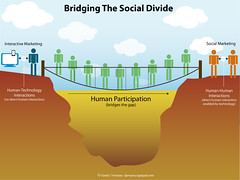
A year ago, I wrote about social media marketing’s scalability problem. It still hasn’t been fully solved, but we’ve seen progress toward a solution.
To reiterate: In theory, using social media for marketing should scale elegantly. In practice, real life starts to get in the way. You can’t create “viral.” People don’t scale, either. Technologies scale, but programs – especially those with a labor-intensive component – don’t.
Now, I see the solution that I didn’t have a name for a year ago: social business design.
Looking back, it’s clearly in the comments:
- “Social media is part of dynamic corporate thinking, which changes organizational culture.” – Helena Makhotlova
- “Integration into a CRM tool, like calls in customer service centers today.” – Adam Cohen
- “You are creating deep relationships through social media marketing, a multiplier effect.” – Aaron Strout
- “Corporations need to build their internal community – then include their markets and customers.” – deb lavoy
- “Training and practice inside the organization – bigger impact if made part of the discipline of the internal staff.” – John Bell
- “Any department with customer contact is already taking the message out into the world.” – Ann Kingman
- “The scale in social media comes from many-to-many interactions.” – Joe Cothrel
- “Sometimes, you simply need to scale up your customer service teams.” – Shiv Singh
- “Part of an overall customer experience management strategy, not marketing per se.” –Larry Irons
Social technologies are best applied inside the enterprise – to improve existing systems, grow culture, improve productivity, and scale to a finite point. Then it requires system design to make everything work in concert.


Interesting… the first thing that comes to my mind is the ‘system design’ of the human body. Lots of discrete but interconnected functions [ideally] working in harmony ; the ability to assess with diagnostics and monitoring; the ability to apply best practices for optimal performance… At what point though do we define the ‘purpose’ of the human body or the enterprise though? Art, war, love, consumption, innovation…
In business I think it’s simple to apply a model of profitability for sustainability. But – just as with the human form – there’s much more that an enterprise can create and deliver as value. With profitability as the presumed primary success metric, is there more that enterprise should be considering in terms of purpose and how does that fit into system design?
Nick – I like your human body metaphor, I think it prompts you to think about all of the intricate relationships in the enterprise. If I might address your question…I think the end goal is always profitability but there are others along the way, by which I mean that you don’t just become profitable. There are components to a business that make it profitable. For example, with our E2.0 efforts we’re focusing on a four-tiered model: Social Networking, Knowledge Sharing, Reuse, Innovation. Is it all encompassing? No. But it touches on many parts of the business that make it more productive & efficient. Lots of our design is based on our company culture and our processes. It might help to examine how your company works and see what areas are appropriate to focus on for setting your goals.
Hi Peter. I’ve seen the “people don’t scale” thing before. I think it was a Hugh McCloud illustration. I don’t agree with that. Coming from a heritage in IT Services, “scale” was the money-maker. (Jeff knows this). An executive team who could scale the business (grow the employee base) while holding costs in check walked away with the prize every time. Also, relationships scale. That’s the secret sauce of network effects in the social ecosystem. The entire weak ties/strong ties discussion is predicated on scaling relationships. Sorry I don’t have time for more thoughtful commentary right now, but some day I hope to dig into this further. Hey, what about that lunch in Austin??? 🙂
Very cool, David – thanks for the reply. Imperative and inherent to E2.0 efforts, I think that companies should put a larger emphasis on the creation of value beyond profit (though that’s a pretty darn important one). Lots of stakeholders yearn for the ROI on social _anything_ in the enterprise yet the ROI of my lungs not talking to my heart via blood is quite binary. Goals and a sense of greater purpose are key indeed.
Peter,
Social media is such a phenomenon because societies are social. Businesses, on the other hand, not so much. Your efforts in “social business design” will improve “existing systems, productivity, and scale” but I’m not yet convinced they will result in other real social business change, e.g., inclusiveness, helpfulness, mentoring, civility. (Having worked on a spec for a social business platform, I know how important permissions are.) What is more apt to happen is that the real social behavior will emerge outside of the enterprise in the form of groups. Groups of marketers. Groups of technologists. Groups of doctors (knock on wood), all of whom will use the tools to share and for good. In fact, I’m convinced social business design will help us cure cancer faster outside a private company than within.
These are indeed interesting times Peter. Go get ‘em.
Hi Peter:
I think this post is just about right on – and I don’t think I agree with @susan above. Companies that hope to enter into more intimate relationships (authentic, helpful, human) with their customers will need people. The efficiency of these employees will be leveraged by technology – but that won’t be the biggest effect.
The biggest effect will come from two places. First, in a connected world where many “interactions” are happening in a public and archival space (the web) many people can observe a company’s behavior with one person. (Not unusual to see a 100:1 read to post ratio in healthy communities.) The second is that people will quickly recognize and be attracted to a company that is willing to enter into more authentic, helpful and human relationships – they will grow advocacy very quickly. Both of these will be accelerators on the 1:1 interaction with customers. As an example see this thread between Toyota Prius product managers (posting as Prius Team but identifying themselves personally in each post) and one of their (non Toyota owned) communities – PriusChat.
http://priuschat.com/forums/gen-iii-2010-prius-main-forum/66511-usb-safety-connect-almost-here.html
This post about the USB Safety Connect got 211 comments/replies and 13,816 views. And it stays visible for at least 12 months. If you google search it, this thread comes up on page 1.
That is an interesting example of the accelerators on one individual interaction.
I think the best way to think about this is that entering in to authentic, helpful, human relationship with your customers is like planting seeds. In addition to the positive experience of each interaction, you will reap a harvest down the road.
One caution – in this hyper connected world, your product is your marketing, and if the product isn’t any good all the interaction in the world won’t matter.
TO’B
Peter
have you read Ctrl-Shift’s blog about volunteered personal information and the impact that has on companies, their culture and internal organisation.
http://ctrl-shift.co.uk/vpi-report/
DM me if you want an offline conversation about it.
Rebecca
Peter — sorry i missed you and Kate in your NYC drive-by. Hopefully we’ll catch up sometime in the near future.
I think we’re viewing the world in a similar way. Certainly, in Converseon’s view, to create sustained value for an enterprise, social media needs to be an “inside-out” approach. This is also daunting for agencies because the “agency of the future,” in our view, is about infusing the value of social into the DNA of an organization and not typical of current approaches. Further, while people don’t scale, culture does. Creating an environment where social can flourish is contagious and generate value across the enterprise, ranging from marketing/communication, legal, HR, R&D, etc. As is often said, social can be technically (relatively) easy, but culturally hard. The value is there but, as tends to always happen, it will take a few enlightened organizations to demonstrate success before it is embraced more broadly. The good news is there are indeed a few out there paving the way. Cheers.
Interesting concept – Social Business Design.
Long before Facebook, Twitter and other “social technologies” made it much easier to participate in “scalable” conversation, successful businesses understood the importance of sensing and responding to their customers and their environment. 3M is well known as an innovative company that seeks to find the signal within the noise of day-to-day experiences. Buckman Labs http://www.buckman.com/ is lesser known, but may be a better example of how an entire organization can be attuned to their customers so well that they can anticipate their customer needs.
Zara is (for me) another excellent illustration of how a company can “listen” to their customers and make decisions using derived insights that truly accelerate their business – leading to competitive advantage. One article describing their approach appeared in late 2005, while their success has been well chronicled.
Fashion forward Zara
by Julia Fein Azoulay (issue no. 22/2005 / December 15, 2005)
http://www.theflorentine.net/articles/article-view.asp?issuetocId=945
With today’s technologies, and with improved tracking capabilities, every company should be better able to sense and respond to customer interactions – whether these interactions are with the company or with other prospective customers.
Social Business Design…I like it.
—–
PING:
TITLE: long live the strategists
URL: http://jburg.typepad.com/future/2009/09/strategic-services.html
IP: 10.17.151.32
BLOG NAME: Jon Burg’s Future Visions
DATE: 09/02/2009 06:46:46 AM
As the corporate world begins to ask the important questions, like Why, How, and Who about social, a new breed of services is becoming increasingly critical to strategic success in a shifting world. And while creativity drives a campaign, strategy…